
Smart Tank Safety: Wireless Monitoring for Breather Valves, Flame Arresters and PVRVs
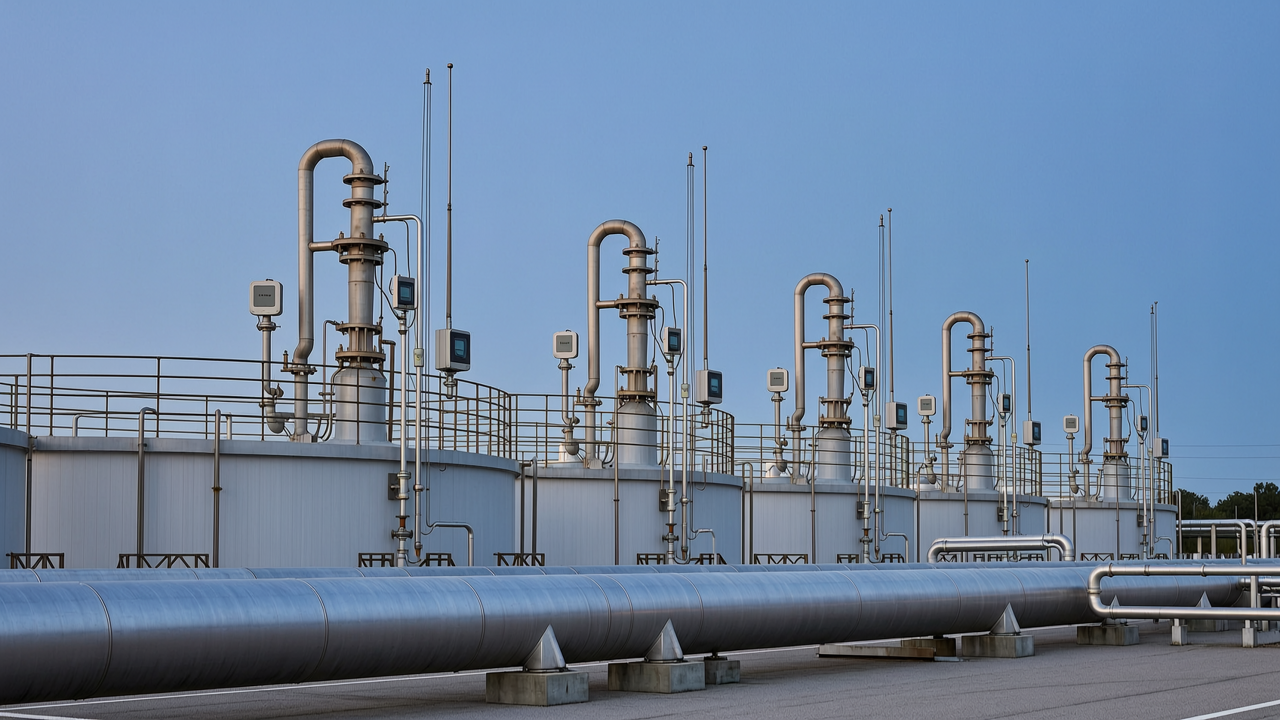
Tank farms are the quiet workhorses of the oil & gas industry — and some of the least monitored assets on site. A storage tank’s pressure/vacuum relief valve (PVRV), breather valve or flame arrester may sit untouched for years. If it fails, the consequences range from product loss and fugitive emissions to a serious safety event.
Wireless monitoring is changing that — and it is the fastest-growing application of intelligent valve technology in terminals and refineries today.
The Problem: Safety Devices That Nobody Looks At
Tank venting equipment is designed to work passively:
- PVRV / breather valves open to relieve overpressure or vacuum — and should reseat tightly afterwards. A valve that fails to reseat leaks vapour continuously.
- Flame arresters protect tanks from flame propagation — but a blocked or corroded element silently loses its protection capability.
- Emergency relief vents must open when needed, after years of sitting idle.
Historically, operators had no way to know:
- Is the PVRV actually closed right now?
- Is it leaking vapour to atmosphere?
- Is the flame arrester element restricted?
- Has the emergency vent ever been tested?
The traditional answer was periodic manual inspection. The modern answer is continuous wireless monitoring.
How Smart Tank Safety Works
The technology stack is built on the same industrial wireless platform used for valve monitoring:
| Layer | What It Does | Typical Products |
|---|---|---|
| Sensing | Detects valve position, pressure/vacuum, or acoustic signature | Discrete position transmitters, wireless pressure transmitters, acoustic transmitters |
| Wireless transmission | Sends data to the control room with no new cabling | WirelessHART (IEC 62591) transmitters and gateways |
| Analytics | Trends data, raises alarms on deviation | Plant asset management / tank monitoring software |
Practical implementations:
- Wireless discrete transmitters (e.g. Rosemount 702 / 802, TopWorx monitors) mounted on PVRV or breather valve stems report open/closed state continuously — proving the valve reseated after each relief event.
- Wireless pressure transmitters on tank vents capture pressure/vacuum trends — the classic retrofit case, since tank roofs have no cable infrastructure.
- Acoustic transmitters (e.g. Rosemount 708) clamp onto the downstream pipe of a pressure relief valve and listen for the ultrasonic signature of a passing valve — detecting leakage or lift without any process penetration.
- Flame arrester condition monitoring is done indirectly, through pressure differential and temperature sensing across the element, plus upstream/downstream pressure monitoring.
Why This Matters Now
Three forces are pushing tank monitoring from “nice to have” to “required”:
- Emissions regulations — tighter control of volatile organic compound (VOC) and methane emissions makes leaking PVRVs a compliance issue, not just a product-loss issue. A single leaking relief valve can vent significant volumes over a year.
- Safety management — proving that relief and flame-arresting devices function is increasingly part of documented safety cases.
- Economics — product loss from leaking vent valves is measurable money. Wireless monitoring converts an invisible loss into an actionable alert.
The barrier to adoption has also collapsed: battery-powered WirelessHART transmitters with ATEX/IECEx certification, multi-year battery life, and mesh networking mean a tank farm can be instrumented without any plant shutdown or cable installation.
A Real Deployment Pattern
A coastal refined-products terminal with over 1 million m³ of storage deployed 146 wireless smart pressure transmitters, supported by 8 wireless repeaters and 8 gateways, replacing mechanical gauges and feeding data directly into the DCS via Modbus TCP.
The result: complete, continuous visibility of tank and pipeline pressures — with zero new cabling.
What to Specify
When evaluating tank safety monitoring, ask for:
- ✅ Hazardous-area certification matching your zone classification (ATEX / IECEx)
- ✅ Battery life of 5–10 years, with published derating data
- ✅ Mesh capability so transmitters can also act as repeaters across a large tank farm
- ✅ Integration with your DCS or asset management platform (Modbus TCP, OPC-UA, HART-IP)
- ✅ Non-intrusive installation — clamp-on or stem-mounted, no process break
- ✅ Reseating verification for relief devices, not just pressure measurement
The Combination That Works
The most effective tank safety package combines:
- Certified safety hardware — PVRVs, breather valves and flame arresters to ATEX/API/ISO requirements
- Wireless monitoring layer — position, pressure and acoustic sensing
- Data integration — alarms and trending in the control room
Hardware alone tells you nothing about condition. Monitoring alone has nothing to monitor. Together, they turn a passive safety device into a managed safety asset.
How SAWYE Can Help
SAWYE supplies certified tank protection equipment — flame arresters, breather valves, pressure/vacuum relief valves — for storage tanks across refineries, terminals and tank farms. Combined with wireless monitoring, we help customers move from periodic inspection to continuous tank safety visibility.
Whether you are specifying new tank farm equipment or retrofitting an existing one, our team can help you define the right scope.
📧 Send Inquiry → websale@sawye.com
🌐 Visit → www.sawye.com
SAWYE — Authorized Distributor of Oliver Valves. 30 years of oil & gas equipment expertise across the Middle East and Southeast Asia.